
There is something about the Au Sable River Valley that seems to attract a particular kind of person.
I don't mean outdoorsmen, exactly. There are plenty of places with outdoorsmen. I don't mean artists, either. And I certainly don't mean the carefully cultivated version of the rugged individualist—the one you can buy by the piece from a catalog.
I mean people who seem unusually comfortable going their own way.
Stubborn people. Curious people. People who can fix things. People who make things. People who are perfectly content being alone, but who also possess a strange compulsion to create something and send it back out into the world.
I've known a surprising number of them.
I grew up in Shiawassee County, where James Oliver Curwood was simply part of the landscape. His castle stands in Owosso. There's a festival named for him. Everybody knows the name. He was our local writer, adventurer and eccentric.
It wasn't until much later that I learned Curwood had another home up north, tucked into the woods by the Au Sable River near Roscommon.
That seemed appropriate.
Curwood wasn't alone.
Ernest Hemingway found something he needed in northern Michigan and its trout streams. Fred Bear left the industrial world downstate and eventually made Grayling the home of a company that would become synonymous with modern bowhunting.
And then there was Fred Kelly.
I had the privilege of meeting Fred. I heard him play guitar. I've been in his shop outside Grayling, where a musician who didn't particularly like the guitar picks available to him eventually decided to make better ones himself.
Why not?
That question seems to occur rather frequently around here.
Every summer, otherwise reasonable people gather in Grayling, put racing canoes into the Au Sable, and paddle through the night all the way to Oscoda.
Why?
Well, apparently somebody once wondered whether it could be done.
It could.
So now they've been doing it for generations.
The famous names are easy to point toward, but they're not really what interests me. I've met too many people around this river whose names won't be written in histories but who nevertheless share something with those that will.
Mechanics who are musicians. Soldiers who are artists. Craftsmen, inventors, builders, writers, fishermen and assorted eccentrics.
My friend Mike is one of them. He's mechanically trained, a retired Army NG Command Sergeant Major, and a wonderful guitarist. Those things might sound incongruous somewhere else.
Around Grayling, somehow they don't.
Maybe there's nothing mystical about it. I'm not sure there needs to be.
Northern Michigan has always offered space. Actual physical space, certainly, but something else as well. Space away from crowds and noise and light. Space away from the constant pressure to become whatever everybody else has agreed a person ought to become.
For generations, people have come north because they wanted some of that space.
And sometimes, given enough room, people become wonderfully difficult to categorize.
They become self-reliant without becoming closed-minded. Rugged without becoming insensitive. Stubborn without losing their curiosity. They learn how to repair an engine and play a guitar. Build a cabin and write a book. Hunt and paint. Weld and sing.
There is toughness here, certainly.
But there is also an extraordinary amount of art.
I've spent enough of my life around people like this that I eventually realized they had affected me.
Not because I wanted to become them.
Because they gave me permission.
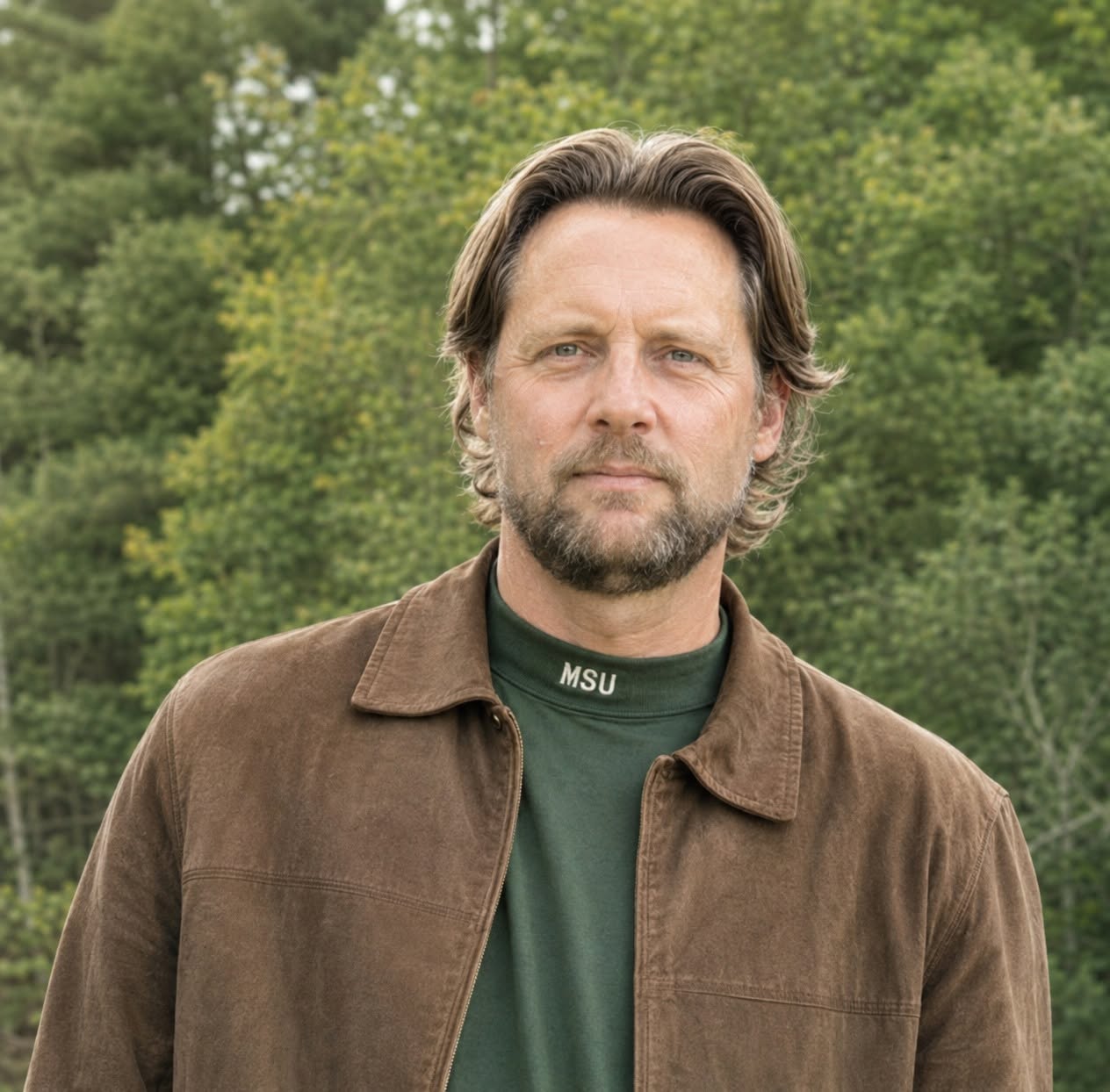
I've been a musician. I've built speakers. I've narrated audiobooks. I've written books. I've worked with electronics and audio equipment and wood. And eventually, somewhat improbably, I began designing and building furniture.
I've spent a fair amount of my life wondering whether I had any business doing one thing or another.
The people I've encountered around the Au Sable offered a wonderfully uncomplicated answer:
Why not?
You don't have to wait for somebody to declare you a furniture designer before you make a piece of furniture.
Make one.
It may be terrible.
Make another one.
Learn something. Change something. Tear it apart if you have to. Pay attention. Develop an opinion. Become stubborn about the things that matter and abandon the things that don't.
Eventually you may make something that couldn't have existed without you.
That idea has become important to the way I think about furniture.
I don't consider my work rustic.
Northern Michigan has no shortage of rustic. It doesn't need my help.
A cabin in the woods doesn't need a bear carved into the arm of a chair to remind us that we're in the woods. A beautiful slab of wood doesn't need a pine tree burned into it to establish its provenance.
The material already knows where it came from.
I'm more interested in what happens when that material encounters discipline.
An irregular slab against deliberate geometry. A natural edge against a straight line. Mass against refinement. Something unapologetically heavy with one small detail that took an unreasonable amount of thought to bring to fruition.
Nature gets a vote.
So does geometry.
The resulting pieces can be difficult to categorize. Some contain traces of mid-century modernism. Some have the mass and material honesty associated with Brutalism. Others follow the wood somewhere I hadn't intended to go.
That's all right.
The people who inspired them have been difficult to categorize, too.
Perhaps that is what I've really taken from this place.
Not an aesthetic.
An attitude.
The willingness to make something without asking whether you're the sort of person who is supposed to make it. The patience to learn how. The independence to decide for yourself when it's right.
And the stubbornness to keep going when it isn't.
The Au Sable Valley Collection isn't named for furniture that looks like northern Michigan.
It doesn't need to.
It's named for a place, and for the people I've known and learned about here, who showed me something much more useful:
You are allowed to try.
Why not?
Robert Shannon HooperSeptember 2026